 |
OTX-Runtime for C++
|
|
|
OTX-Runtime for C++
|
|
The OTX-Runtime API 2nd generation is a complete new implementation based at C++ (versions 6.4.x and higher). It is independent from the former 1st generation of OTX-Runtime API (DotNet, Java). Applications which based at the 1st generation can be migrate to the OTX-Runtime API 2nd generation. The picture shows the main structure of the OTX-Runtime API 2nd generation.
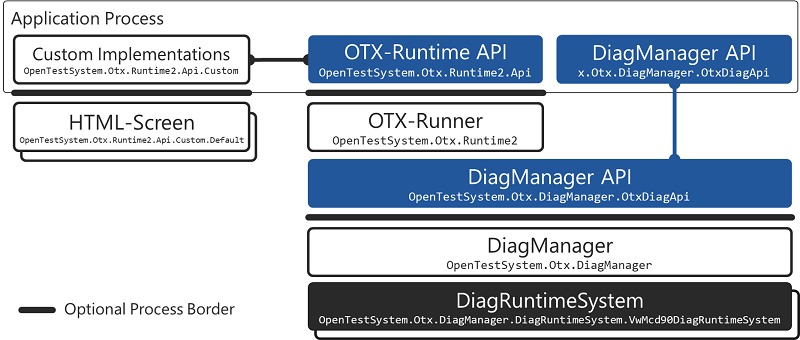
The main differences between OTX-Runtime API 1st and 2nd generation are listed in the following table.
| Feature | 1st Generation | 2nd Generation | Description |
|---|---|---|---|
| OTX Runner | Own process | Own process or inside application process | OTX Runner is the process where the OTX logic will be executed |
| IPC Between Runner and API | Sockets | Sockets, Pipe or Raw | IPC means inter process communication. Raw do not need IPC. |
| Diagnostic Runtime System (MVCI) | Inside Runner | Outside Runner inside OTX-DiagManager API | DiagManager can be run inside its own process and is stand-alone usable |
| IPC Between Runner and DiagManager | - | Sockets, Pipe or Raw | IPC means inter process communication. Raw do not need IPC. |
| Configuration and start Diagnostic Runtime System | Implicit inside Runner | Explicit with DiagManager | IPC means inter process communication. Raw do not need IPC. |
| Implementations for access to external systems | Implicit inside Runner | Explicit outside Runner inside so called Custom Implementations | CustomImplementations can be changed by the user. A default custom implementation with the same functionality like in 1st generation will delivered together with the OTX-Runtime API. Some custom implementations, e.g. DefaultCustomScreenImplementation must be set explicitly, see example below. |
| API entry point | RuntimeManager | RuntimeManagerFactory and IRuntimeManager | The main structures of the APIs are very similar |
The basic proceeding how the OTX-Runtime API 2nd generation can be used is described in the following pseudo code example. The example executes the main procedure of a PTX file.
OTX file related to the examples above.