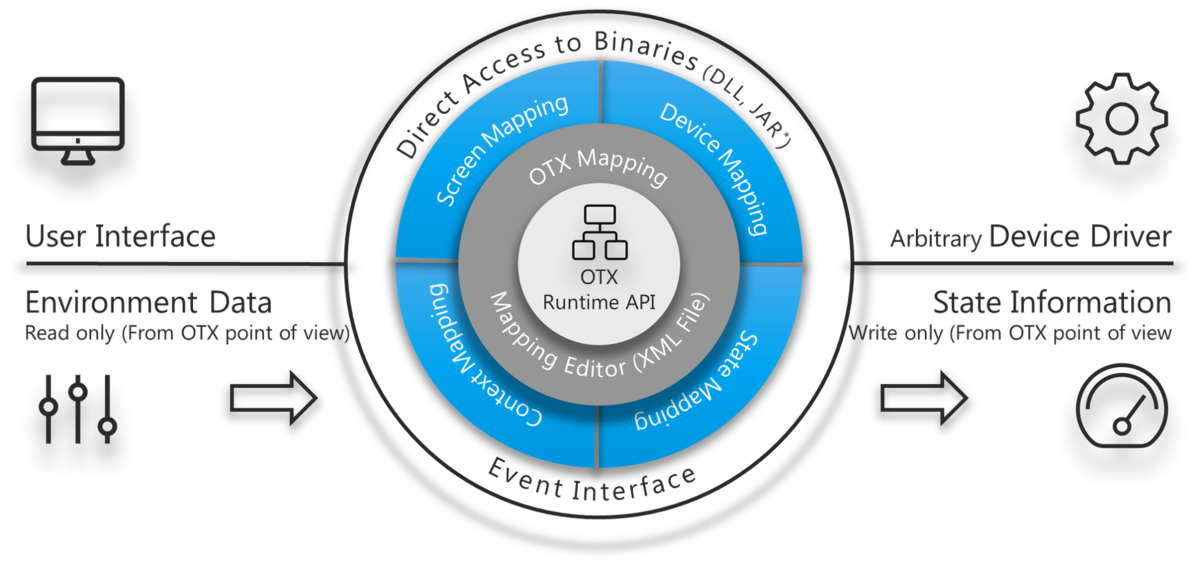
One of the most important benefits of OTX is the strict separation of test logic and runtime implementation. The so-called “OTX Mapping” provides platform-independent access to arbitrary external systems. It can be edited within the graphical OTX Mapping Editor.
Advantages:
- Unlimited access to any external systems
Enables unrestricted communication with any external systems from within OTX, e.g., test bench hardware, measurement data acquisition, web services, or specialized graphical interfaces.
- Platform-neutral
The user can, for example, implement a screen for their target platform or use the provided default implementation for .NET.
- All mapping information in a single file
All mapping information is stored in one file. By exchanging this file, the same OTX can be executed on different systems.
Further information:
- Details of OTX Mapping
How to use OTX mapping?
- OTX-Mapping Data Type Conversions
Which OTX data types can be used for communication with external systems?
- OTX-Mapping Scripting Support
Invocation of Lua or Python scripts for computationally intensive, non-process-related functions.
